Evangelista, J. E., Clarke, D. J. B., Byrd, A. I., Srinivasan, S., Srinivasan, S., Maurya, M. R., Jenkins, S. L., Diamant, I., Sanchez, E., Xie, Z., Olaiya, S., Kim, H., Marino, G. B., Ahmed, N., Ramachandran, S., Subramaniam, S., & Ma'ayan, A. (2026). The CFDE Workbench: Integrating Metadata and Processed Data from Common Fund Programs. Journal of molecular biology, 169631.
Projects & Publications
Research and Software
Below you can find the publications and projects I have contributed to with links to external sources where applicable.
Publications
Marino, G. B., Byrd, A. I., Ahmed, N., Clarke, D. J. B., & Ma'ayan, A. (2025). sc2DAT: workflow for targeting tumor subpopulations of single cells. Bioinformatics advances, 5(1), vbaf237.
Clarke, D. J. B., Evangelista, J. E., Xie, Z., Marino, G. B., Byrd, A. I., Maurya, M. R., Srinivasan, S., Yu, K., Petrosyan, V., Roth, M. E., Milinkov, M., King, C. H., Vora, J. K., Keeney, J., Nemarich, C., Khan, W., Lachmann, A., Ahmed, N., Agris, A., Pan, J., Ramachandran, S., Fahy, E., Esquivel, E., Mihajlovic, A., Jevtic, B., Milinovic, V., Kim, S., McNeely, P., Wang, T., Wenger, E., Brown, M. A., Sickler, A., Zhu, Y., Jenkins, S. L., Blood, P. D., Taylor, D. M., Resnick, A. C., Mazumder, R., Milosavljevic, A., Subramaniam, S., & Ma'ayan, A. (2025). Playbook workflow builder: Interactive construction of bioinformatics workflows. PLoS computational biology, 21(4), e1012901.
Marino, G. B., Ahmed, N., Xie, Z., Jagodnik, K. M., Han, J., Clarke, D. J. B., Lachmann, A., Keller, M. P., Attie, A. D., & Ma'ayan, A. (2023). D2H2: diabetes data and hypothesis hub. Bioinformatics advances, 3(1), vbad178.
Marino, G. B., Ngai, M., Clarke, D. J. B., Fleishman, R. H., Deng, E. Z., Xie, Z., Ahmed, N., & Ma'ayan, A. (2023). GeneRanger and TargetRanger: processed gene and protein expression levels across cells and tissues for target discovery. Nucleic acids research, 51(W1), W213-W224.
Projects
Project
D2H2
Diabetes Data and Hypothesis Hub (D2H2): A platform that facilitates data-driven hypothesis generation for the diabetes and related metabolic disorder research community.
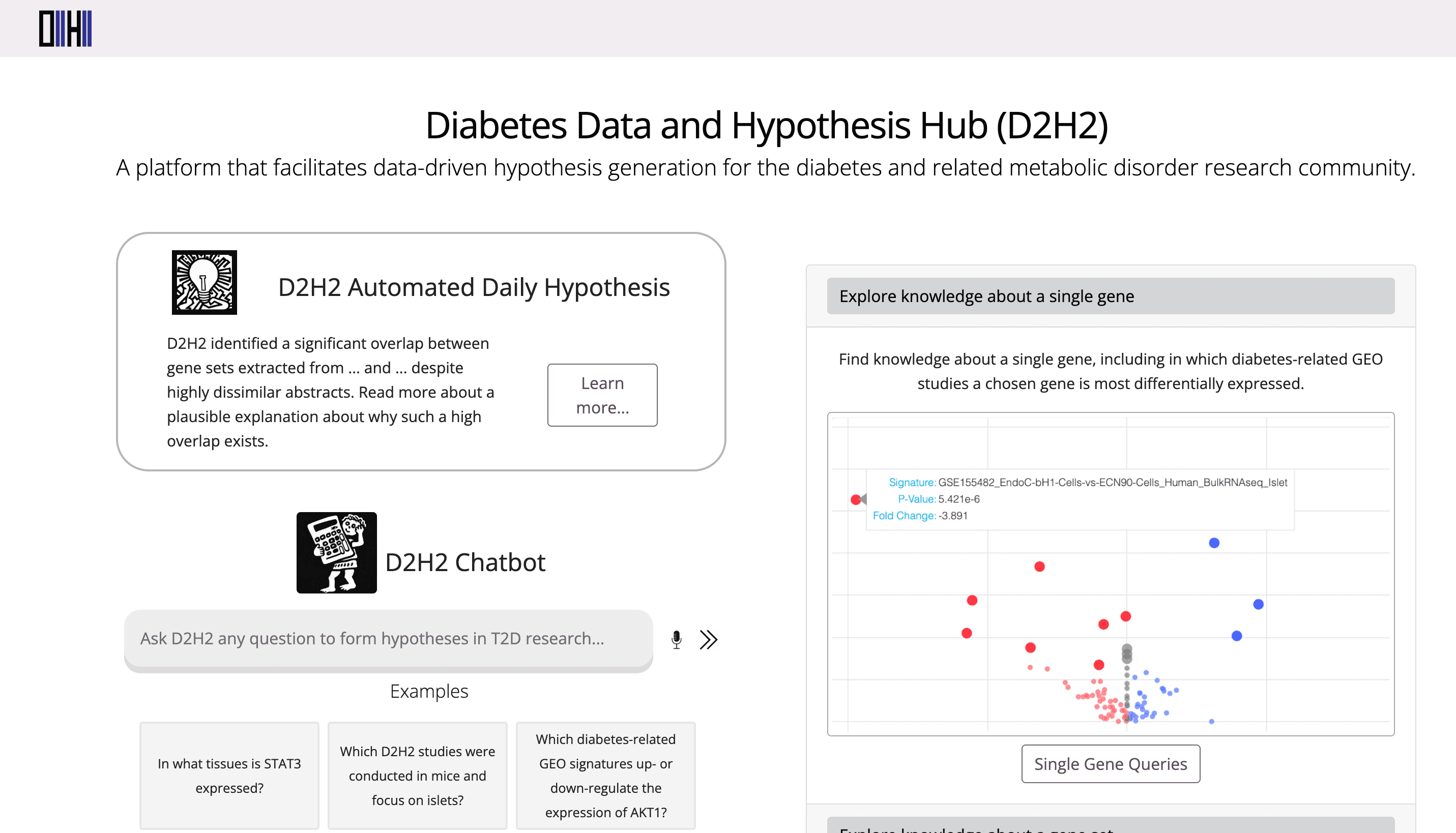
There is a rapid growth in the production of omics datasets collected by the diabetes research community. However, such published data are underutilized for knowledge discovery. To make bioinformatics tools and published omics datasets from the diabetes field more accessible to biomedical researchers, we developed the Diabetes Data and Hypothesis Hub (D2H2). D2H2 contains hundreds of high-quality curated transcriptomics datasets relevant to diabetes, accessible via a user-friendly web-based portal. The collected and processed datasets are curated from the Gene Expression Omnibus (GEO). Each curated study has a dedicated page that provides data visualization, differential gene expression analysis, and single-gene queries. To enable the investigation of these curated datasets and to provide easy access to bioinformatics tools that serve gene and gene set-related knowledge, we developed the D2H2 chatbot. Utilizing GPT, we prompt users to enter free text about their data analysis needs. Parsing the user prompt, together with specifying information about all D2H2 available tools and workflows, we answer user queries by invoking the most relevant tools via the tools’ API. D2H2 also has a hypotheses generation module where gene sets are randomly selected from the bulk RNA-seq precomputed signatures. We then find highly overlapping gene sets extracted from publications listed in PubMed Central with abstract dissimilarity. With the help of GPT, we speculate about a possible explanation of the high overlap between the gene sets. Overall, D2H2 is a platform that provides a suite of bioinformatics tools and curated transcriptomics datasets for hypothesis generation.
Project
FarmWithFriends
An interactive farming game where users can engage in the farming lifestyle individually as well with friends.
We created an interactive farming game where users have to the opportunity to engage in the farming lifestyle individually as well with friends. There is a finite two dimensional space and every player can pick a plot of land in this space and grow crops for profit. After a certain amount of time, you can harvest the crops and make a profit (Think Stardew Valley). However, there is a catch: if your friend(s) gets to your crops before you, they can steal a portion of your crops and profit. With the money you can make, you can buy more things that increase profit (such as upgrading your farm to not only sell crops but also handle livestock), cosmetic upgrades, or more fun cosmetic items.
Project
Effect of Bone Suppression on X-Ray Classification
Investigating whether the suppression of bone shadows can improve disease recognition in computational models for X-ray classification.
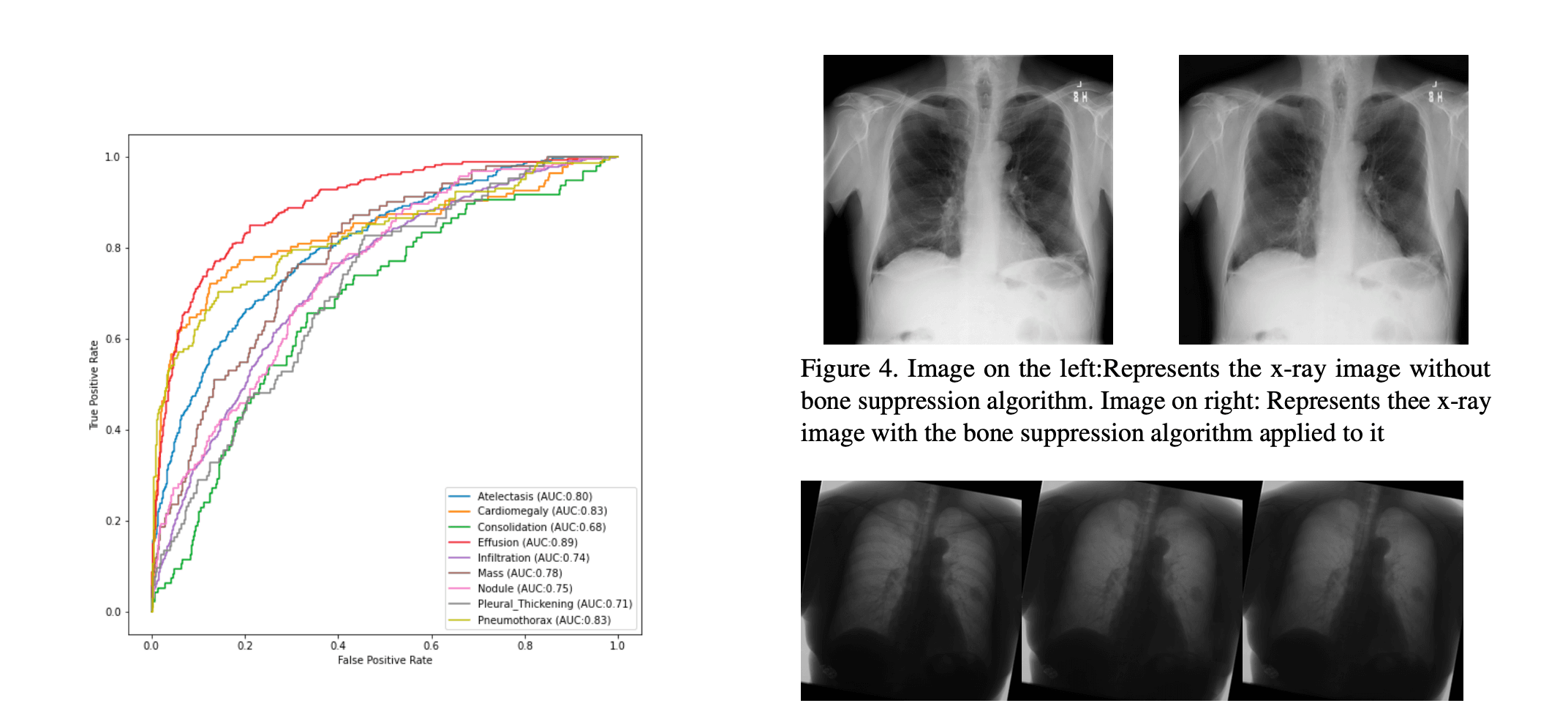
Modern technological advances have fundamentally changed the intersection between medicine and computer science. Through the fields of artificial intelligence (machine/deep learning), computational models have become valuable tools for both data analysis and classification. In this project, we focus on the latter and aim to compare classification performance across images with and without feature suppression. We chose to focus on medical imaging data sets and,specifically, X-ray images where bone shadows have been shown to impede visual classification by medical profession- als. We therefore aim to investigate whether the suppression of such shadows can also improve disease recognition in computational models. Here we use a Convolutional Neural Network (CNN) for classification and an Auto-encoder for bone suppression. This is a challenging task as images vary highly in quality, contrast and bone shadow intensity. A sig- nificant performance increase for bone shadow suppressed images would provide evidence that bone shadow suppres- sion is an effective de-noising process that should be applied before X-ray classification models.
Project
CT to MRI Image Converter
Converting CT images to MRI images using deep learning techniques.
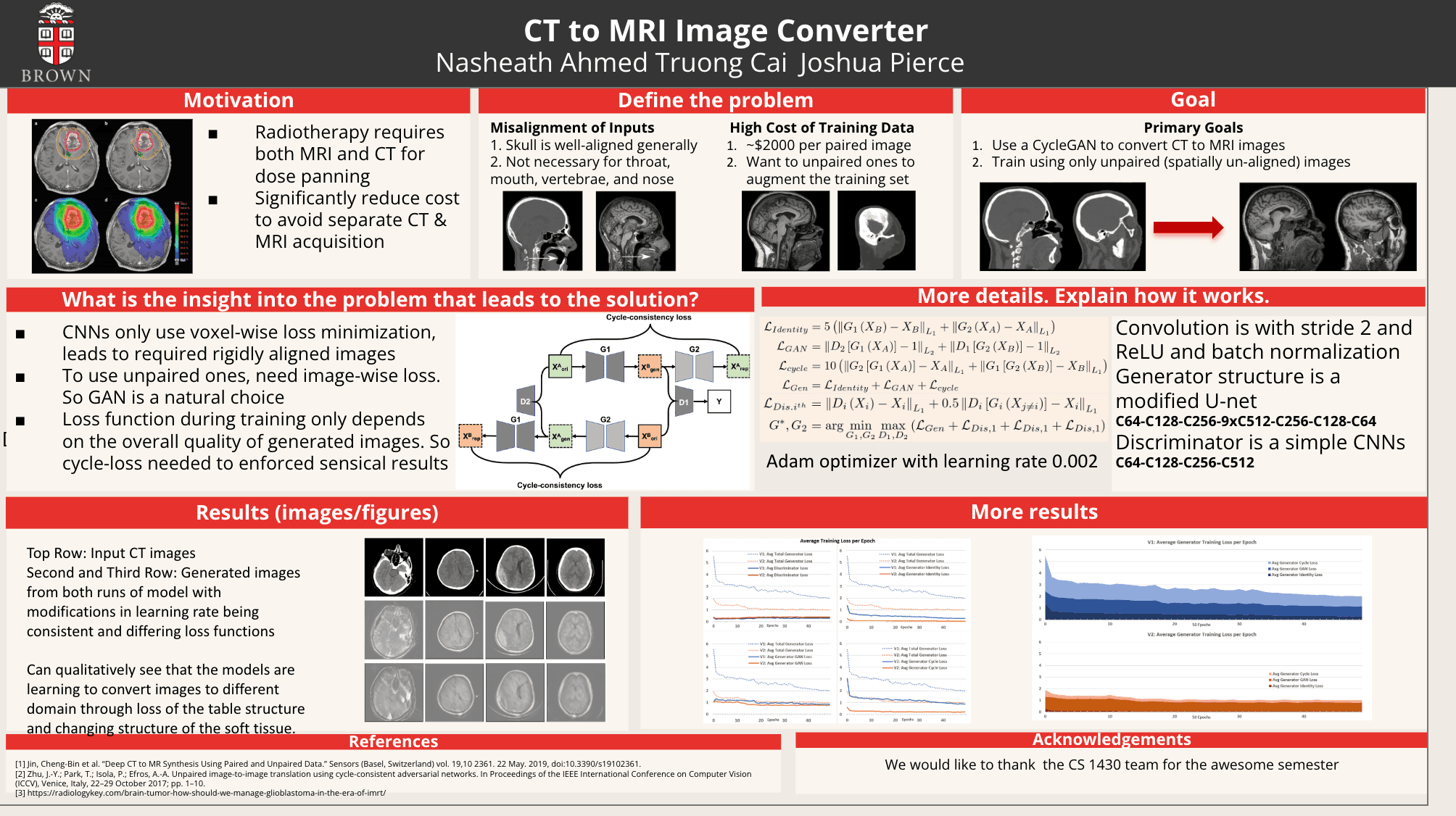
This project focuses on converting CT images to MRI images using deep learning techniques. The goal is to create a model that can accurately transform CT scans into MRI-like images, which can be useful for medical diagnosis and treatment planning. We adapated the CycleGAN architecture to achieve this goal and trained on unpaired spatiall unaligned iamges.